Paper list

Edge Object Detectors

OV-DEIM: Real-time DETR-Style Open-Vocabulary Object Detection with GridSynthetic Augmentation

OV-DEIM: Real-time DETR-Style Open-Vocabulary Object Detection with GridSynthetic Augmentation

Leilei Wang, Longfei Liu, Xi Shen, Xuanlong Yu, Ying Tiffany He, Fei Richard Yu†, Yingyi Chen†

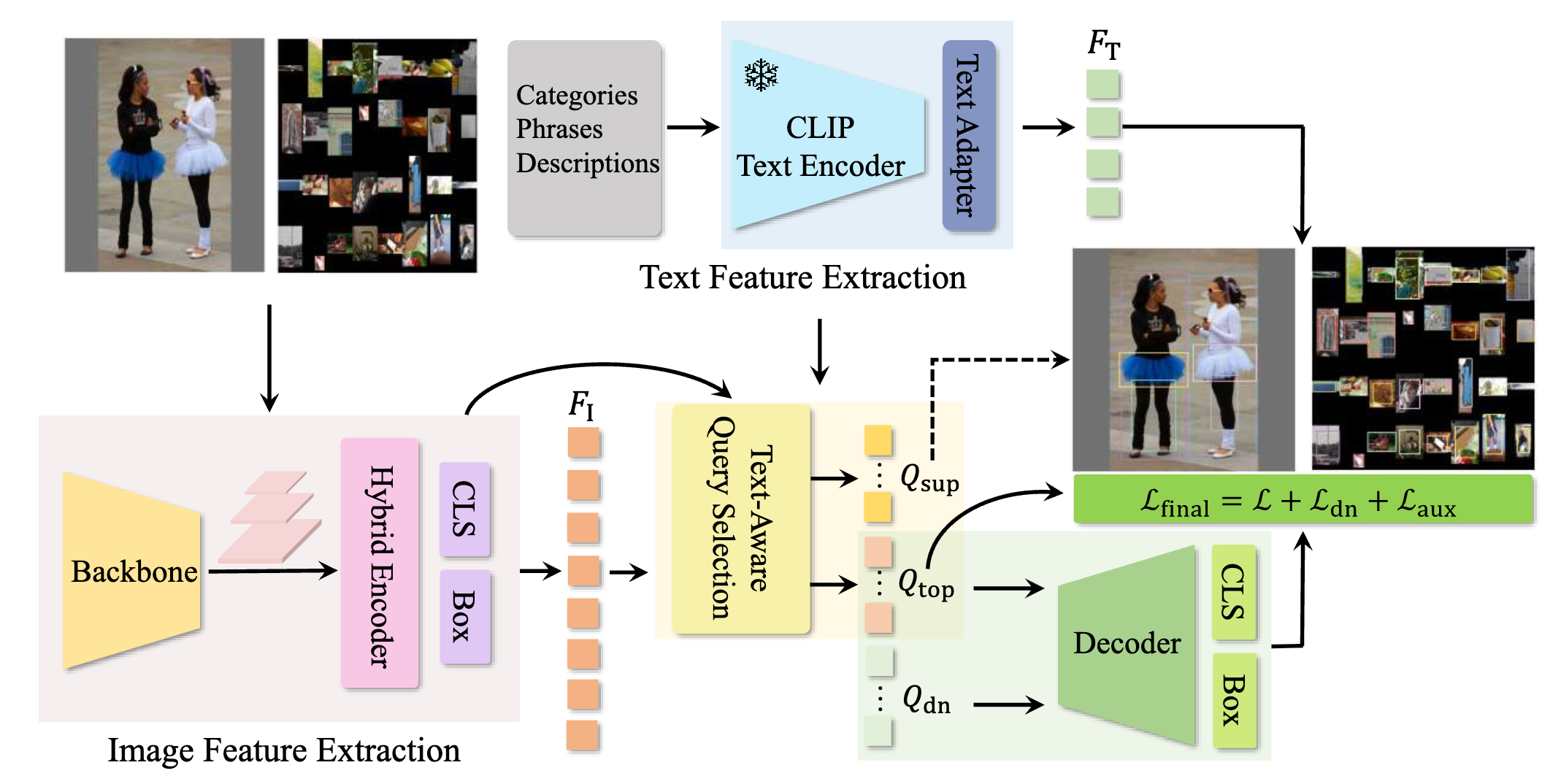
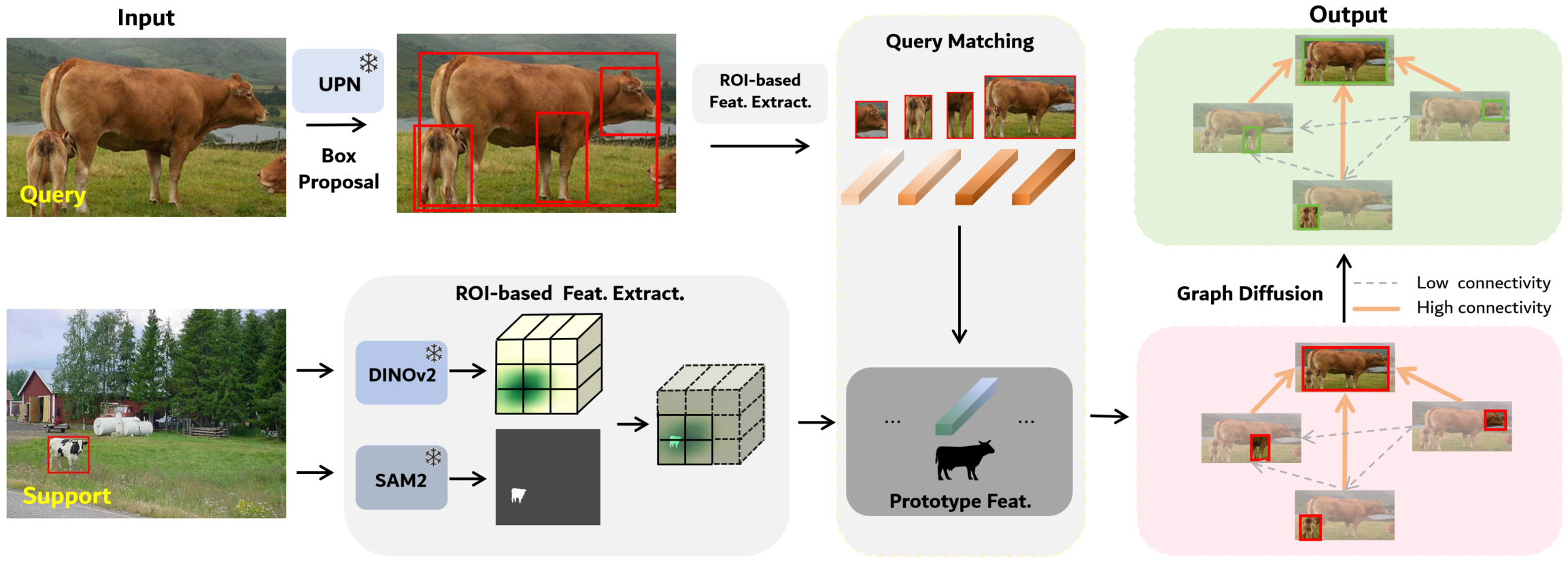
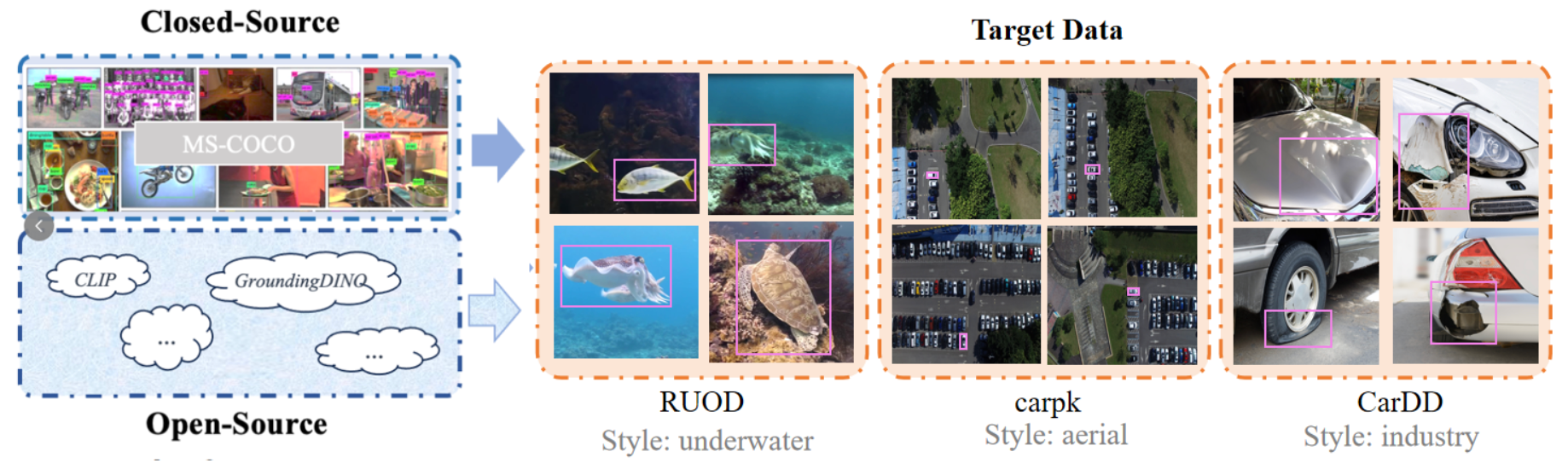
Abstract: Real-time open-vocabulary object detection (OVOD) is essential for practical deployment in dynamic environments, where models must recognize a large and evolving set of categories under strict latency constraints. Current real-time OVOD methods are predominantly built upon YOLO-style models. In contrast, real-time DETR-based methods still lag behind in terms of inference latency, model lightweightness, and overall performance. In this work, we present OV-DEIM, an end-to-end DETR-style open-vocabulary detector built upon the recent DEIMv2 framework with integrated vision-language modeling for efficient open-vocabulary inference. We further introduce a simple query supplement strategy that improves Fixed AP without compromising inference speed. Beyond architectural improvements, we introduce GridSynthetic, a simple yet effective data augmentation strategy that composes multiple training samples into structured image grids. By exposing the model to richer object co-occurrence patterns and spatial layouts within a single forward pass, GridSynthetic mitigates the negative impact of noisy localization signals on the classification loss and improves semantic discrimination, particularly for rare categories. Extensive experiments demonstrate that OV-DEIM achieves state-of-the-art performance on open-vocabulary detection benchmarks, delivering superior efficiency and notable improvements on challenging rare categories.

EdgeCrafter: Compact ViTs for Edge Dense Prediction via Task-Specialized Distillation

EdgeCrafter: Compact ViTs for Edge Dense Prediction via Task-Specialized Distillation

Longfei Liu*, Yongjie Hou*, Yang Li*, Qirui Wang*, Youyang Sha, Yongjun Yu, Yinzhi Wang, Peizhe Ru, Xuanlong Yu†, Xi Shen†

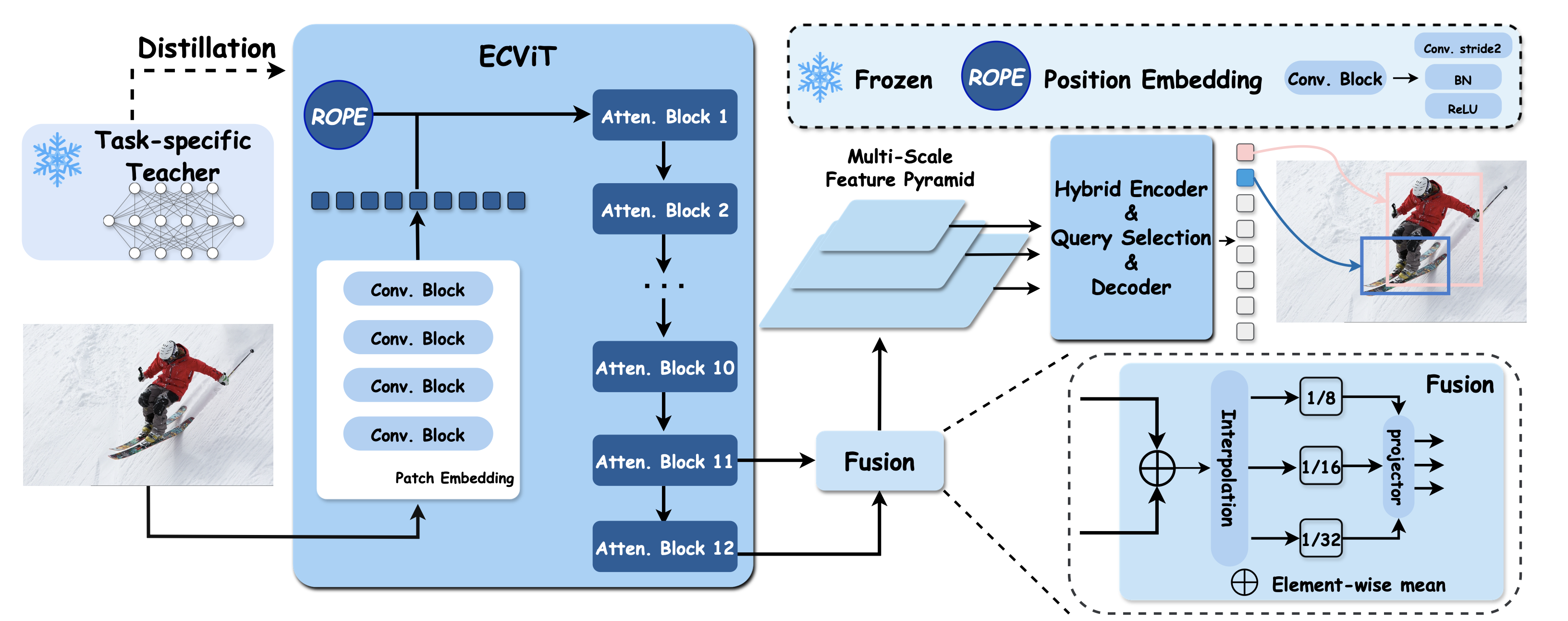
Abstract: Deploying high-performance dense prediction models on resource-constrained edge devices remains challenging due to strict limits on computation and memory. In practice, lightweight systems for object detection, instance segmentation, and pose estimation are still dominated by CNN-based architectures such as YOLO, while compact Vision Transformers (ViTs) often struggle to achieve similarly strong accuracy efficiency tradeoff, even with large scale pretraining. We argue that this gap is largely due to insufficient task specific representation learning in small scale ViTs, rather than an inherent mismatch between ViTs and edge dense prediction. To address this issue, we introduce EdgeCrafter, a unified compact ViT framework for edge dense prediction centered on ECDet, a detection model built from a distilled compact backbone and an edge-friendly encoder decoder design. On the COCO dataset, ECDet-S achieves 51.7 AP with fewer than 10M parameters using only COCO annotations. For instance segmentation, ECInsSeg achieves performance comparable to RF-DETR while using substantially fewer parameters. For pose estimation, ECPose-X reaches 74.8 AP, significantly outperforming YOLO26Pose-X (71.6 AP). These results show that compact ViTs, when paired with task-specialized distillation and edge-aware design, can be a practical and competitive option for edge dense prediction.

Real-Time Object Detection Meets DINOv3

Real-Time Object Detection Meets DINOv3

Shihua Huang*, Yongjie Hou*, Longfei Liu*, Xuanlong Yu, Xi Shen†

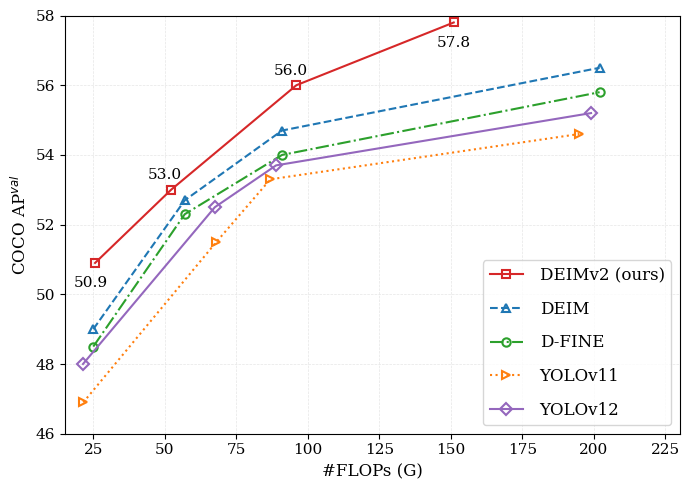
Abstract: Driven by the simple and effective Dense O2O, DEIM demonstrates faster convergence and enhanced performance. In this work, we extend it with DINOv3 features, resulting in DEIMv2. DEIMv2 spans eight model sizes from X to Atto, covering GPU, edge, and mobile deployment. For the X, L, M, and S variants, we adopt DINOv3-pretrained or distilled backbones and introduce a Spatial Tuning Adapter (STA), which efficiently converts DINOv3's single-scale output into multi-scale features and complements strong semantics with fine-grained details to enhance detection. For ultra-lightweight models (Nano, Pico, Femto, and Atto), we employ HGNetv2 with depth and width pruning to meet strict resource budgets. Together with a simplified decoder and an upgraded Dense O2O, this unified design enables DEIMv2 to achieve a superior performance-cost trade-off across diverse scenarios, establishing new state-of-the-art results. Notably, our largest model, DEIMv2-X, achieves 57.8 AP with only 50.3 million parameters, surpassing prior X-scale models that require over 60 million parameters for just 56.5 AP. On the compact side, DEIMv2-S is the first sub-10 million model (9.71 million) to exceed the 50 AP milestone on COCO, reaching 50.9 AP. Even the ultra-lightweight DEIMv2-Pico, with just 1.5 million parameters, delivers 38.5 AP, matching YOLOv10-Nano (2.3 million) with around 50 percent fewer parameters.